What Terroir Means for Your Home
Share
The place is not the backdrop. It is the ingredient itself.
When you open a bottle of wine, the sommelier does not tell you what grape was used. They tell you where it came from. Burgundy. Bordeaux. The Rhône Valley. Because with wine, everyone understands that the same grape grown in different soil, under different sun, in different rain, produces something fundamentally different.
Fragrance works the same way. We just have not been talking about it that way.
The word for this in wine is terroir. It describes the complete natural environment in which a plant grows: the soil, the climate, the elevation, the rainfall, the way the light falls in a particular valley at a particular time of year. All of these things shape the aromatic character of a plant. They always have. The fragrance industry has known this for centuries. It is only recently that the people buying fragrance have started to ask about it.
At Aurelia L’Atelier, the origin of every natural material in our formulas is not a footnote. It is a decision.
Grasse and the Rose That Only Has Two Weeks
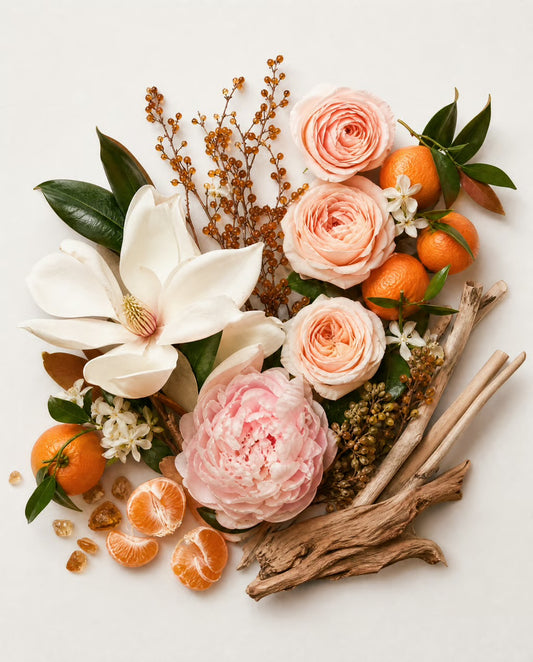
There is a rose that grows in Grasse, France, in the Alpes-Maritimes region of the French Riviera, that can only be harvested during a window of approximately two weeks each May. The Rosa centifolia, the cabbage rose, blooms briefly and without compromise. It is picked by hand at dawn before the heat of the day opens the petals and begins to dissipate the fragrance.
This is Rose de Mai. And almost all of the world’s annual production is purchased by two of the most recognized fragrance houses in history before it ever reaches anyone else.
The rose absolute produced from these petals is warm, slightly waxy, honeyed. Not a fresh rose. Not a bright rose. The rose of something that has already happened, of a room that remembers rather than a garden in bloom. That specific character comes from this specific place. A rose absolute produced in Bulgaria, Egypt, or Morocco is a different material. It smells of rose. But it does not smell of this rose.
Rose de Mai is at the center of Voile, our third room fragrance. It is in this bottle because no other material does what it does.
Calabria and the Fruit That Grows Nowhere Else
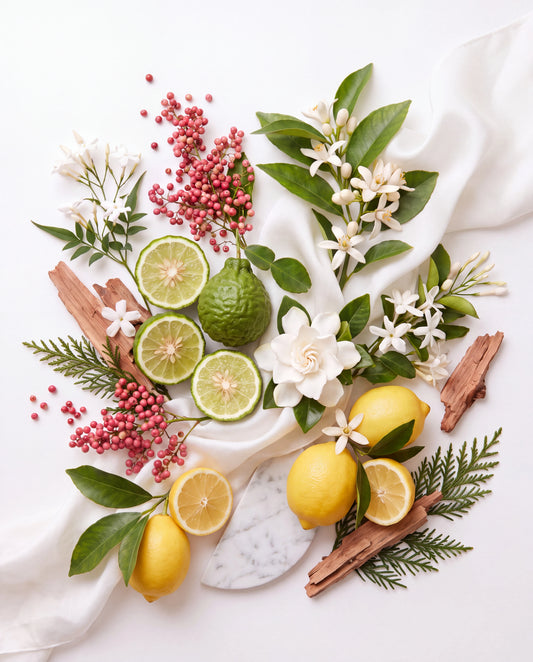
The bergamot fruit, Citrus bergamia, is one of the strangest and most specific raw materials in perfumery. It is not quite a lemon. Not quite an orange. It grows almost exclusively on a narrow coastal strip in Calabria, in the southernmost tip of Italy, where the microclimate of the Mediterranean coastline produces a fruit with a complexity that cannot be replicated anywhere else.
You have smelled Calabrian bergamot before. It is the defining note of Earl Grey tea. That bright, slightly floral, faintly bitter citrus quality that makes a cup of tea feel like a particular afternoon rather than just a hot drink. That is bergamot from this specific coastline.
The bergamot in Étage Privé is cold-pressed from Calabrian fruit. Not extracted with heat. Not treated with chemicals. Cold-pressed, which preserves the full aromatic character of the rind exactly as it exists on the tree. The opening of Étage Privé, cool, architectural, immediate, comes from this.
Madagascar and the Root That Takes Months to Distill
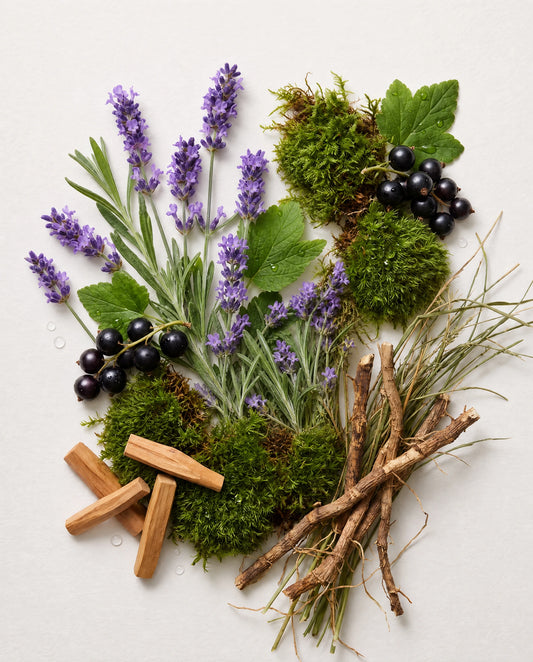
Vetiver is a grass. The roots of Chrysopogon zizanioides are cleaned, dried, cut, and soaked before being steam-distilled in a process that can take many hours. The result is one of the most tenacious natural materials in perfumery. On a smelling strip it lasts over 400 hours.
The finest vetiver was historically produced on the island of Réunion, then known as Île Bourbon, which is why the variety is still called Bourbon vetiver even though Réunion no longer produces it in commercial quantities. That tradition now lives in Madagascar, where the volcanic soil and specific climate of the island produce a vetiver that is smoky, earthy, deep, with an undertone of hazelnut and loam that no other origin quite replicates.
Haitian vetiver is greener. Indonesian vetiver is lighter. Madagascar Bourbon vetiver is the one that makes a formula feel like it has roots. It is in the base of Dedans for exactly that reason.
Why This Matters for a Room
A room fragrance is not a perfume. It does not develop on warm skin. It disperses into the air and settles into fabric and changes the atmosphere of a space. The materials that do this best are the ones with depth and specificity, the ones that carry something with them from where they came from.
When you spray Dedans into a room, the Madagascar vetiver in the base is doing something that a generic woody synthetic cannot do. It is bringing a specific earthy warmth that comes from a specific volcanic soil from a specific island in the Indian Ocean. You cannot smell the island. But you can feel the depth it produces.
That is what terroir means in fragrance. Not that you can taste the terroir the way you might in a wine. But that the place where something grows shapes what it becomes, and what it becomes shapes how a room feels.
Most home fragrance tells you what a place smells like. Aurelia tells you what the materials from that place contribute to the fragrance.
That is a different thing entirely.
Aurelia L’Atelier formulates home fragrance from raw materials chosen for their origin and character. Collection No. I is available at latelieraurelia.com.